

The most popular and an important artifact in Scrum, the product backlog is never complete. It is ever evolving, as a project’s requirements or environment evolves and changes. It is simple yet purposeful, if used wisely. It lists down all the features, functions, requirements, environment, remediating defects and more. Put simply, it is a prioritized list of work remaining that is necessary to bring the product to life.

A high functioning product backlog has four main qualities of a description, estimation, order, and is constantly updated, which helps ensure that the details are always aligned with the big picture. This is represented by DEEP* – Detailed Appropriately, Estimated, Emergent and Prioritized.
*DEEP acronym was coined by Mike Cohn and Roman Pichler
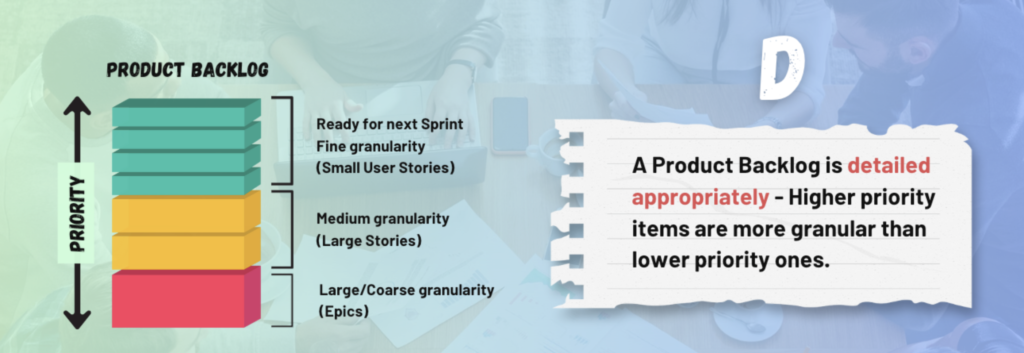
Detailed Appropriately – Product backlog items are detailed in such a way that higher priority items are more granular and detailed than lower priority ones. The lower the priority, the less detail it carries.
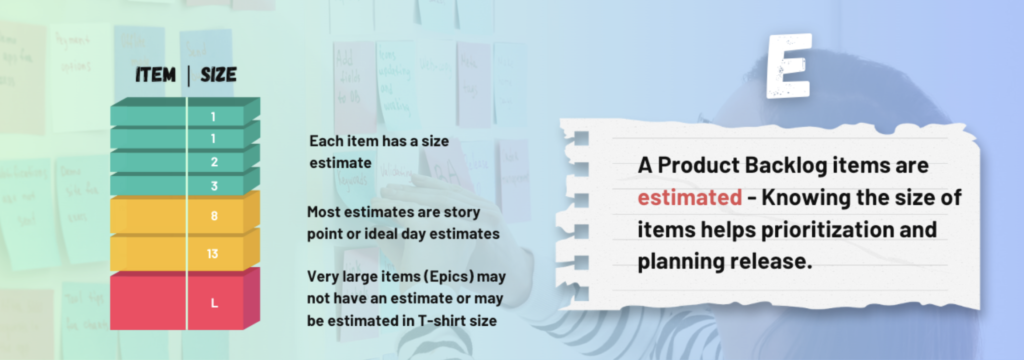
Estimated – Product backlog items are estimated. Estimates are not final and often expressed in story points or ideal days (the number of days of effort that it would take to get a story done if the team worked with no interruptions). Knowing the size of the items helps prioritizing and planning the release. While lower-priority items will have less precise estimates than higher-priority items in the top of the backlog, all should still have a rough estimate.
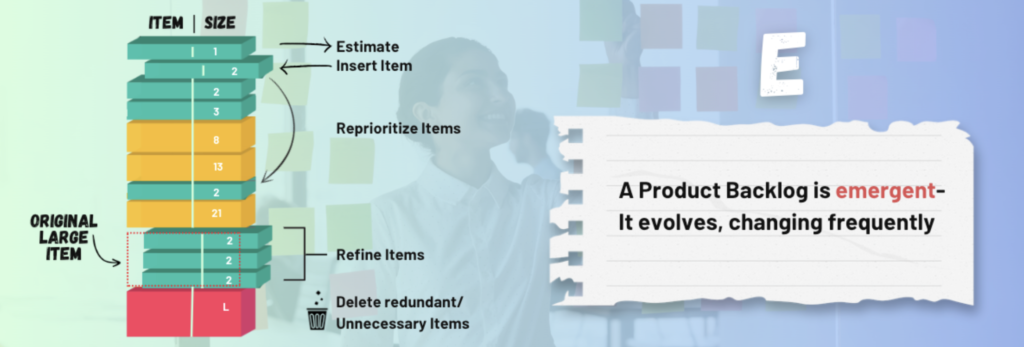
Emergent – Product backlog is organic; it constantly evolves, changing frequently as new items are discovered and added based on user and customer feedback. Existing items are reprioritized, modified, refined or removed – continually.
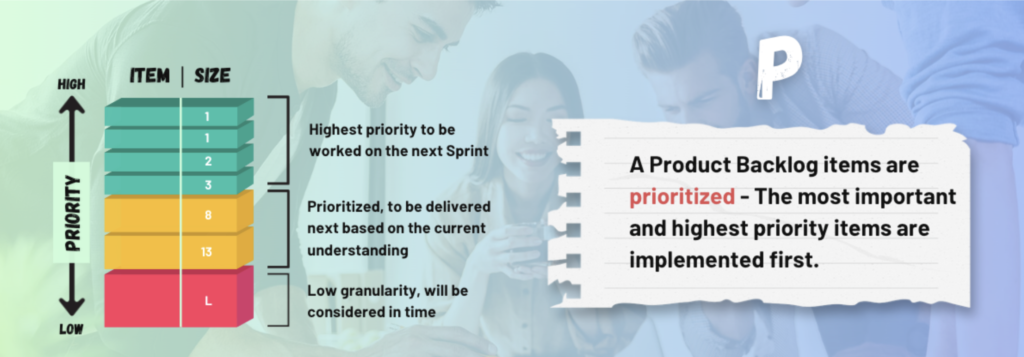
Prioritized – Product backlog items are prioritized. The most important and highest priority items are implemented first. These are found at the top of the backlog. Once an item is done, it can be removed from the backlog. Lesser priority items which can be considered later in time can be found towards the bottom of the product backlog. Teams always complete the highest priority items first to ensure that the value of the product is maximized.

Though the whole Scrum Team collaborates and contributes to grooming, maintaining a product backlog is the responsibility of the Product Owner. 10% of the Scrum Team’s availability and capacity is allocated for grooming. Since grooming is a continuous process in the sprint, the Product Owner continuously updates and refines the product backlog. Ensuring that the product backlog is DEEP through regular grooming sessions helps establish that the product backlog does not become a black hole of redundant, unnecessary and useless items, features and stories. Maintaining a well groomed DEEP backlog will help you succeed with Agile.
This post combines the author’s personal thoughts, ideas, and experiences, with some refinement provided by our Agile Bot AgiNomi.
If you’re leading a high-stakes initiative – in tech, AI, or innovation – OutcomeEdge is here to make sure it actually lands.
We partner with visionary leaders ready to move fast, align their teams, and deliver real impact.
You’ve got great people. But results are stuck. Our Outcome Discovery workshop reveals the root causes behind delivery slowdowns, misaligned priorities, and team fatigue.
Too many teams are overbuilt, underpowered, or unclear. We help you design outcome-focused pods: right size, right skills, right rituals.

Agile Coach
I’m a leader who serves as an Agile Coach in organizations.
I help senior leadership plan long-term strategic decisions while embracing the Agile mindset.
I also work with teams to help them become self organizing on their journey of providing value to the customers.
I see my clients as creative, resourceful, and whole and I’m here to walk alongside them to achieve business outcomes.

Transformation Partner (Agilonomics)
Amitabh (Amit) Sinha is a global transformation leader who helps organizations supercharge their teams and eliminate dysfunctions. Drawing on Patrick Lencioni’s Five Dysfunctions of a Team framework, Amit guides teams to move up the maturity curve—building trust, fostering accountability, and aligning around outcomes.
As Founder of Agilonomics, he has enabled Fortune 500 companies and high-growth organizations to set up teams the right way—establishing processes that actually work, scaling collaboration across business and technology, and introducing the right tools with the right practices.
In partnership with Recro, Amit ensures that every team built through Recro is not only staffed with top talent, but also equipped to function as one unit, deliver consistently, and create lasting impact.