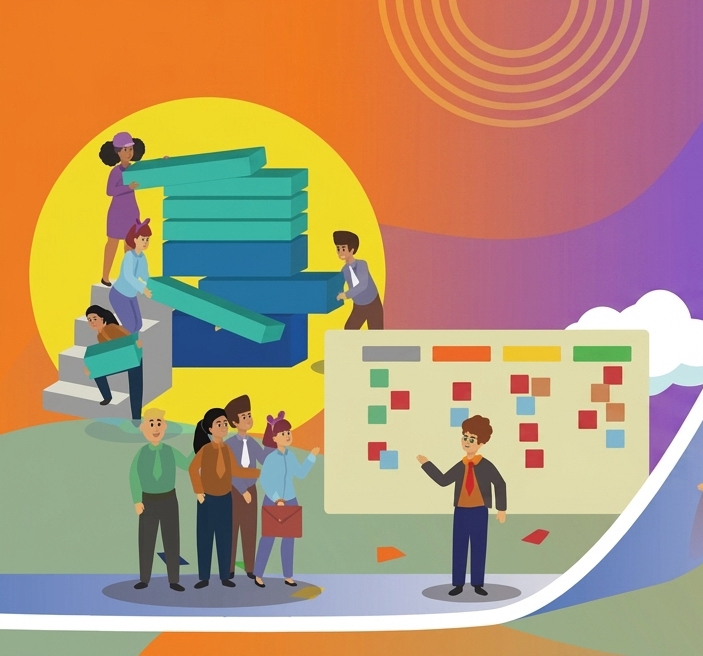

Agile Transformation in simple words means creating effectiveness in teamwork through Agile Mindset that impacts behaviors and culture and organizes people into effective teams (as opposed to working groups) to deliver high value to users and customers.
A wise Agile implementation will have these 3 characteristics:

Enabling teams and individuals to operate at their best potential while delivering high value to the business is a desired goal of any organization. Agile principles in action help teams improve their responsiveness to customer needs, negotiate market shifts better, and expedite the delivery of high-quality products and services.
Wise Agile transformations cultivate safety, trust, and sustained growth among team members, while also promoting continuous improvement, empowerment for iterative processes, and a culture of learning and evolution.
The modern business landscape is complex and dynamic. Organizations must adopt Agile mindset and behaviors to remain competitive, flexible, innovative, and achieve faster time-to-market.
Successful and effective Agile Transformation involves:
As you can see, an effective Agile Transformation involves the whole village – individuals, teams, managers, leaders and executives. Everyone needs to show up and do their part to positively impact the mindsets, behaviors, culture and results! With this approach the Agile Transformation will not only be effective, but also long lasting and reflect in end-end behaviors (bottom-up and top-down).
While all of the above is desirable and may seem easy on paper, it is very hard to achieve. The change agent Agile Coaches often lack necessary skills and fail to grapple with the demands of a holistic end-end Agile transformation. This highlights the importance of selecting Agile coaches who are solid in their foundations and exemplify strong purpose and core values.
Organic Agile transformation begins with a focus on people. Engaging leaders, encouraging transparency and leading by example are important ingredients of a successful transformation. Embracing Agile values and principles, patience and striving for continuous improvement are some factors that contribute to successful transformation. Authenticity and purpose are foundational to effective Agile Leadership. Staying true to core values, striving to grow employees and genuinely caring for people can drive meaningful change.
Establishing an Agile Practice Group and supporting a culture of continuous improvement are key to sustaining Agile transformation. By promoting human values and prioritizing transparency, accountability, and learning, organizations can navigate change with confidence and resilience.
When selecting Agile Coaches, look out for the ones that standout with strong core values and purpose. An effective Agile Coach will go beyond just fixing processes and serve as a role model, bringing up greatness in individuals and teams.
Go for coaches who remember that true transformations come from within and cannot be imposed from outside. Effective coaching includes leaders to be part of the transformation. No transformation can be complete by excluding leaders and managers who serve the teams undergoing Agile transformation.
At Agilonomics, we offer a proven “Agile Transformation Blueprint” refined over two decades, facilitating impactful transformations across various organizations led by renowned servant leader Agile coaches
Agile Transformation is not a goal but a journey of cultural shift and continuous improvement. It should not be only about processes but more about empowering individuals, teams, and organizations to become more adaptive, collaborative, and responsive.
Effective Agile Transformation involves embracing Agile values and principles, engaging leaders, cultivating transparency, and leading by example. Creating a culture where people feel safe, empowered, and valued is key to driving meaningful change from within.
Selecting the right Agile Coach is crucial. Look for coaches who embody strong core values, prioritize authenticity and purpose, and understand that true transformations come from within.
This post combines the author’s personal thoughts, ideas, and experiences, with some refinement provided by our Agile Bot AgiNomi.
If you’re leading a high-stakes initiative – in tech, AI, or innovation – OutcomeEdge is here to make sure it actually lands.
We partner with visionary leaders ready to move fast, align their teams, and deliver real impact.
You’ve got great people. But results are stuck. Our Outcome Discovery workshop reveals the root causes behind delivery slowdowns, misaligned priorities, and team fatigue.
Too many teams are overbuilt, underpowered, or unclear. We help you design outcome-focused pods: right size, right skills, right rituals.

Agile Coach
I’m a leader who serves as an Agile Coach in organizations.
I help senior leadership plan long-term strategic decisions while embracing the Agile mindset.
I also work with teams to help them become self organizing on their journey of providing value to the customers.
I see my clients as creative, resourceful, and whole and I’m here to walk alongside them to achieve business outcomes.

Transformation Partner (Agilonomics)
Amitabh (Amit) Sinha is a global transformation leader who helps organizations supercharge their teams and eliminate dysfunctions. Drawing on Patrick Lencioni’s Five Dysfunctions of a Team framework, Amit guides teams to move up the maturity curve—building trust, fostering accountability, and aligning around outcomes.
As Founder of Agilonomics, he has enabled Fortune 500 companies and high-growth organizations to set up teams the right way—establishing processes that actually work, scaling collaboration across business and technology, and introducing the right tools with the right practices.
In partnership with Recro, Amit ensures that every team built through Recro is not only staffed with top talent, but also equipped to function as one unit, deliver consistently, and create lasting impact.