

Many organizations continue to struggle with grasping the true value of a full-time Scrum Master. The dedicated role of a Scrum Master often faces scrutiny and is not fully understood.
One common argument against having a full-time ScrumMaster is the perception that it’s not justified or affordable.
Here is a conversation I had with a hiring manager who was budgeting for roles in his Scrum Team.
Me[Amit]: “Hey Steve!”. “I heard you have decided against hiring a full time Scrum Master for your team?”
Steve: “Exactly! We need to optimize costs and make the most of our resources. Hiring a full-time ScrumMaster seems like an unnecessary expense.”
Me: “I completely understand the budget concerns, Steve. However, having a full-time ScrumMaster allows for dedicated focus and expertise, leading to faster resolution of issues and increased team efficiency. The impact on project success and customer satisfaction is remarkable.”
Steve: “Hmm, I hadn’t considered that perspective. But what about the team’s self-organization? Won’t a ScrumMaster hinder their autonomy?”
Me: “Great question, Steve! A skilled ScrumMaster empowers teams by coaching and mentoring them in self-organization. They foster a culture of accountability, continuous improvement, and knowledge sharing. Ultimately, this strengthens the team’s ability to make informed decisions and adapt to change.”
Steve: “Amit, I hear your perspective, but I’m curious, do you have any data or evidence to support the value of having a full-time Scrum Master? It would be helpful to see some concrete examples or statistics.”
Me: “I’m glad you asked, Steve! Over the years, I’ve collected data and observed significant improvements in teams that have had the benefit of a dedicated Scrum Master. Let me share some compelling insights with you.”
I pull out a few artifacts working with different teams in various organizations and show them to Steve.
Me: “Take a look at this data. Studies like these have consistently shown that teams with a dedicated Scrum Master demonstrate higher productivity and improved delivery quality. They help remove impediments, facilitate collaboration, and ensure everyone is aligned with the Agile principles.”
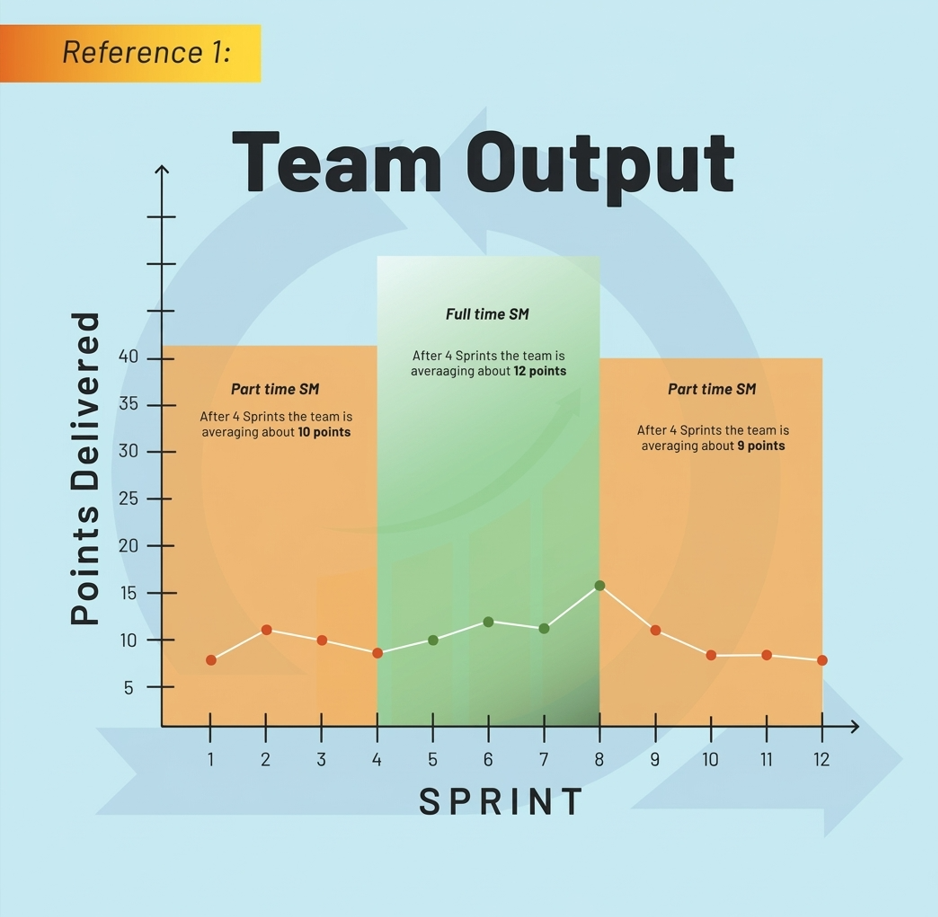
This controlled (POC) study working with a team shows average velocity increased ~20% in about 4 Sprints by transitioning to a full time SM and started to fall down when switched back to a developer playing the role
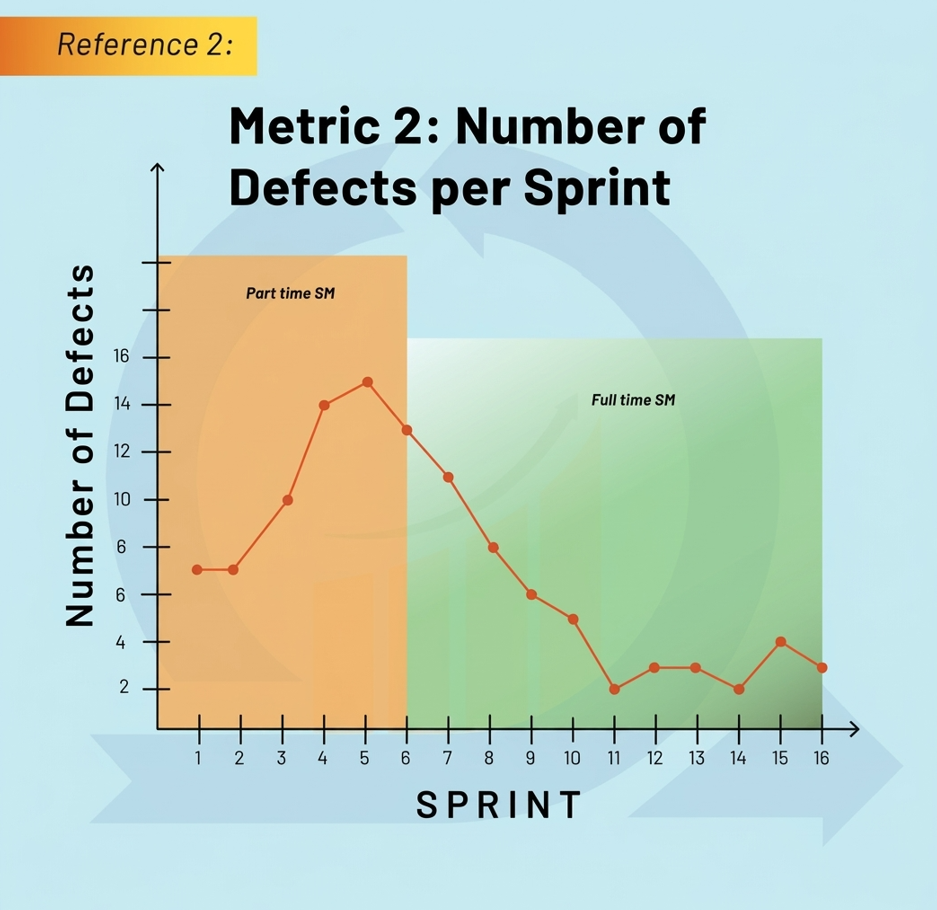
Another controlled study done over a 4 month period showed average number of defects moved up from 8(S1-3) to 13(S4-6) and then dropped to 8(S7-9) and dropped further to 3(S10-13) and stayed low at 3(S14-16)
Without a full-time Scrum Master(1-6), the team faced challenges in quality control and defect prevention. However, with the involvement of an experienced dedicated Scrum Master, the team raised impediments that helped them receive support in implementing effective quality assurance practices, organizing training sessions, and improving their skills. This resulted in a gradual reduction in the number of defects over time
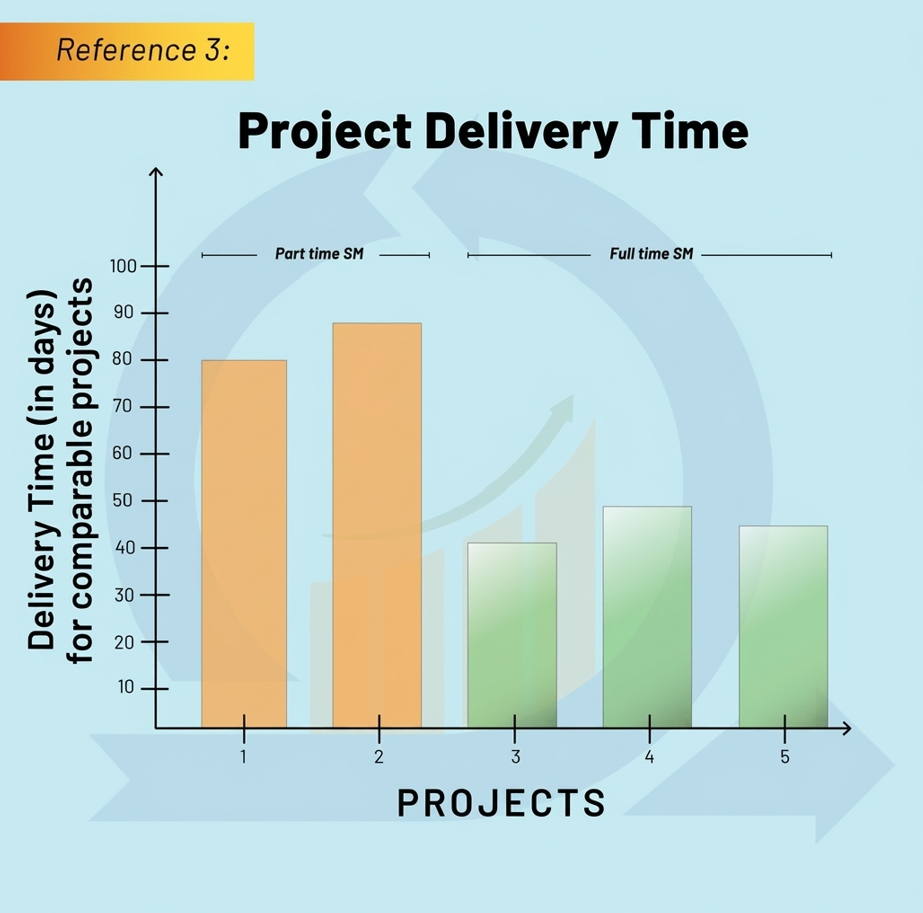
Initially, without a full-time Scrum Master(Project 1 and 2), the team faced challenges in coordination, communication, and managing dependencies. However, with the introduction of a full-time Scrum Master(Project 3, 4 and 5), they experienced improved collaboration, better communication channels, effective teamwork, trust, and camaraderie. This resulted in shorter project delivery times over time.
Steve: “Well, that’s interesting. But can’t we assign these responsibilities to someone part-time? Keep that part time role dedicated to playing Scrum Master for an extended time? We have budget constraints, you know.”
Me: “By having a full-time ScrumMaster, you’re investing in the long-term success of your teams. They become more self-reliant, adaptable, and resilient, which contributes to higher employee satisfaction and retention.”
Steve: Deeply thinking….I see and couldn’t agree more. We need to break free from the misconception that a full-time ScrumMaster is an unnecessary expense. The benefits they bring to the table far outweigh the costs.
Steve was convinced and invested in long term agility for his teams and organization by hiring most Scrum Masters in full time dedicated capacity. The Scrum Masters were nurtured and empowered to play their roles effectively.
The data clearly demonstrates the positive impact of having a full-time Scrum Master. Although there were initial challenges, the dedicated Scrum Master played a crucial role in improving team velocity, reducing defects, and shortening project delivery times.
The support provided by the Scrum Master, including coaching, training, and facilitating effective collaboration, allowed the team to overcome obstacles and continuously improve.
Investing in a full-time Scrum Master proves to be beneficial for achieving higher productivity, improved quality, and timely project deliveries.
Remember, agile success isn’t just about implementing a process; it’s about fostering a culture of collaboration, transparency, and continuous learning. Invest in full time dedicated Scrum Masters and empower them to unleash their full potential. They will help your teams achieve greatness!
If you’re leading a high-stakes initiative – in tech, AI, or innovation – OutcomeEdge is here to make sure it actually lands.
We partner with visionary leaders ready to move fast, align their teams, and deliver real impact.
You’ve got great people. But results are stuck. Our Outcome Discovery workshop reveals the root causes behind delivery slowdowns, misaligned priorities, and team fatigue.
Too many teams are overbuilt, underpowered, or unclear. We help you design outcome-focused pods: right size, right skills, right rituals.

Agile Coach
I’m a leader who serves as an Agile Coach in organizations.
I help senior leadership plan long-term strategic decisions while embracing the Agile mindset.
I also work with teams to help them become self organizing on their journey of providing value to the customers.
I see my clients as creative, resourceful, and whole and I’m here to walk alongside them to achieve business outcomes.

Transformation Partner (Agilonomics)
Amitabh (Amit) Sinha is a global transformation leader who helps organizations supercharge their teams and eliminate dysfunctions. Drawing on Patrick Lencioni’s Five Dysfunctions of a Team framework, Amit guides teams to move up the maturity curve—building trust, fostering accountability, and aligning around outcomes.
As Founder of Agilonomics, he has enabled Fortune 500 companies and high-growth organizations to set up teams the right way—establishing processes that actually work, scaling collaboration across business and technology, and introducing the right tools with the right practices.
In partnership with Recro, Amit ensures that every team built through Recro is not only staffed with top talent, but also equipped to function as one unit, deliver consistently, and create lasting impact.