

Are collocated teams a relic of the past? Perhaps not entirely. Yet, in my experience as a consultant working with various companies, remote team members have become increasingly common. As businesses expand their global presence, the need for collaboration across multiple sites has intensified. Additionally, consulting firms take advantage of opportunities to serve clients, often deploying consultants across continents for fulfilling roles and skills needed for projects. These dynamics add layers of complexity, sparking debates over which approach (Collocation vs. Remote) yields superior ROI.
While many leaders lean towards staffing from multiple remote sites for its perceived ease of access to diverse skill sets and cost efficiency, passionate Agile enthusiasts think otherwise. They argue that collocated teams are possible and manageable but demand a broader vision and a deeper understanding of their inherent value. Contrary to common assumptions, collocated teams can yield long-term cost savings, although not much data is available to drive home this point.
The word “remote” is so open to interpretation that it is not surprising to see how the definition of “remote teams” has changed over the years as outlined below:

One local team and one remote site: Initially, a company might have its main team in one location and a smaller remote team in another.

One local team and multiple remote sites: As the company grows, it might establish remote teams in various locations to tap into diverse talent pools.
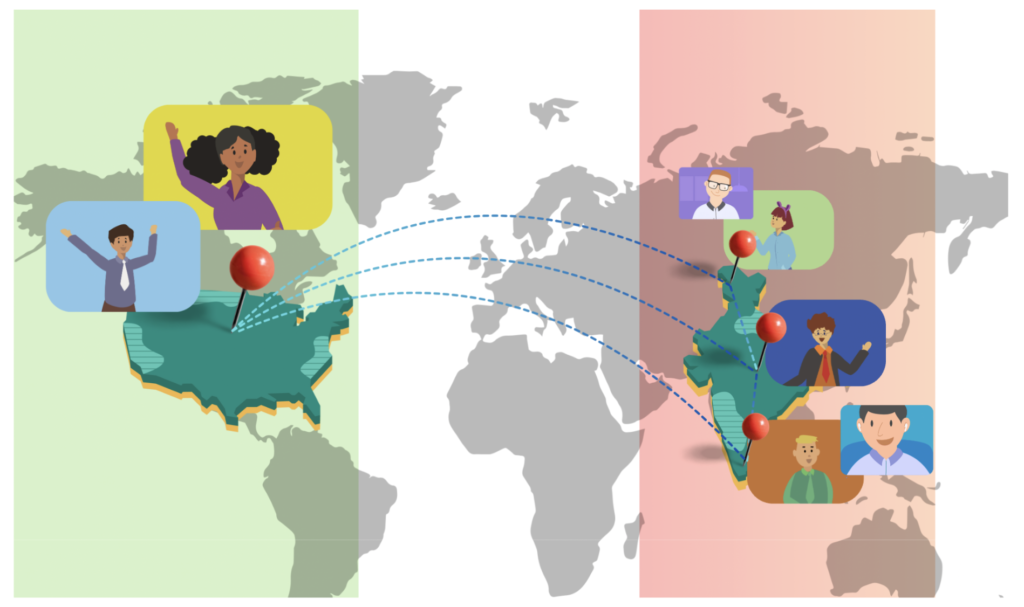
All remote sites in the 2nd time zone: For example, a company based in San Francisco might have all its remote teams located in different cities in India, such as Bangalore, Delhi, Hyderabad, and Mumbai.

Multiple remote sites in multiple time zones: As operations expand globally, remote teams might be spread across different countries, each in its own time zone, such as India, Romania, and Argentina.
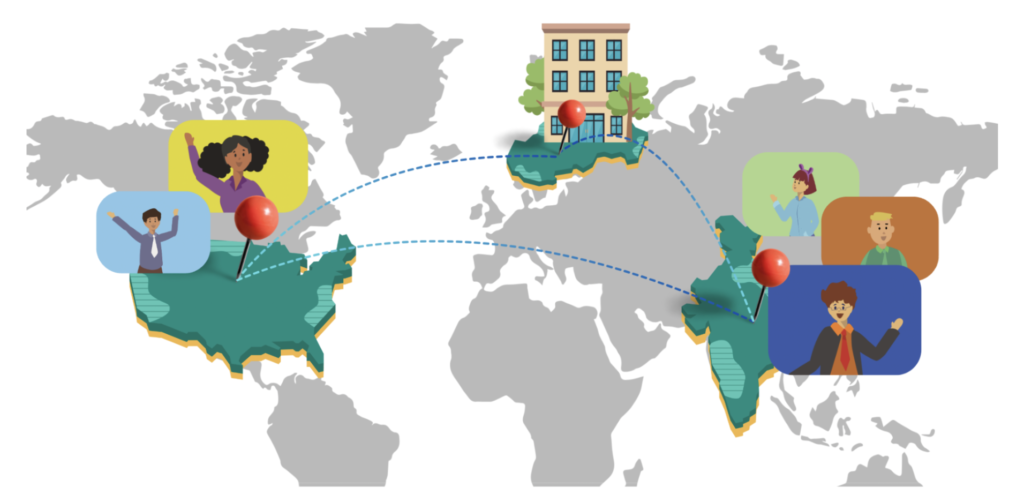
Remote sites from contracting companies: Sometimes, companies partner with external firms to fulfill specific project needs, leading to remote teams with different corporate backgrounds and work practices. However, aligning their ways of working with Agile principles can be challenging.
Example, while Coaching a team for cross functionality, I introduce planning poker for anonymous estimations to have open conversations on every team member’s work. Everyone participates whole heartedly and learns from one another and eventually begin to swarm and co-own each other’s work. But, a recent team reported that its remote team members were from separate consulting firms and their SOWs did not allow them to share their expertise with members from other consulting firms. This created an impediment to increasing cross functionality.
These different setups showcase the diverse ways in which companies adapt to distributed workforces, each presenting its own set of advantages and complexities.

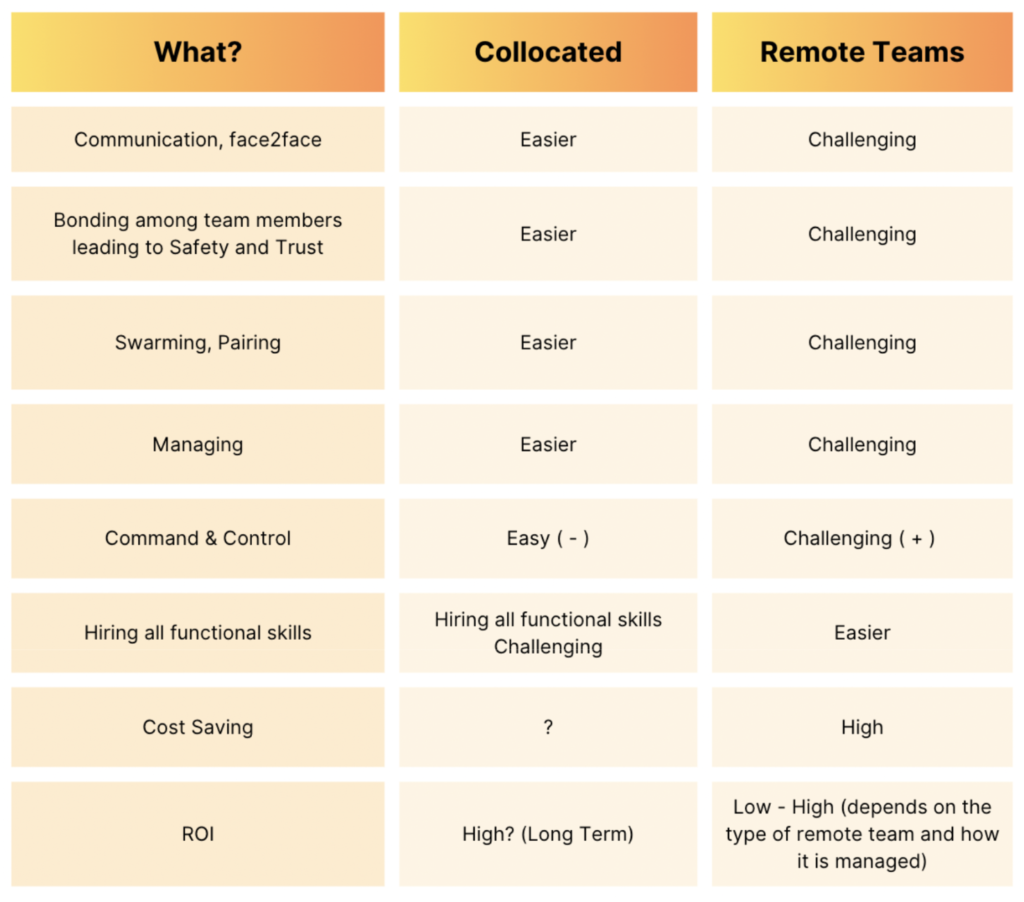
Collocated teams offer several advantages. Face-to-face communication is easier, fostering better bonding among team members and enabling activities like swarming and pairing. Additionally, managing such teams is often more straightforward, although it may inadvertently encourage a command-and-control management style. However, hiring individuals with all the necessary functional skills for a collocated team can be challenging.
On the other hand, remote teams present their own set of challenges and benefits. While face-to-face communication is more challenging, technology can bridge this gap to some extent. Building trust and safety within remote teams can be more difficult, but it’s not impossible with deliberate efforts. Managing remote teams requires more attention to coordination and communication. Interestingly, the remote setup often promotes a more decentralized, empowering leadership style. Hiring diverse talent for remote teams is generally easier, and remote setups can potentially offer cost savings, although the actual return on investment (ROI) varies based on factors like team structure and management approach, safety and trust established among the team members.

It’s surprising how some individuals refuse to be with reality. Take, for instance, a recent conversation I had with a newly appointed Agile Coach at a company undergoing Agile Transformation.
Frustrated, he blamed the leadership’s failure to grasp the significance of collocated teams. He firmly believed that a comparative analysis of funding and ROI between teams with multiple remote members and those comprising solely collocated members would reveal the value and superiority of collocated teams. And he’s not wrong. The seamless workflow, face2face communication, and efficient delivery, among other advantages associated with collocated teams far outweigh the perceived cost savings of hiring remote contractors.
However, what he fails to recognize is the transitional nature of leadership’s understanding. Merely expressing dissatisfaction and complaining won’t get their buy-in. Instead, I advised him to build connections with leaders, demonstrate his value through a few tangible transformations in select teams, find a champion leader to buy into his idea and support him to stand one collocated model team to prove the difference. Convincing leadership demands compassion, intelligence, and above all, patience and servant leadership skills. It’s a journey that requires time and perseverance.
Here are some key strategies to reduce the challenges associated with remote teams:
Maximize Overlapping Hours: Encourage team members to adjust their schedules to ensure there’s significant overlap in working hours. This might mean starting early or working late to accommodate different time zones.
Embrace Video Communication: Encourage a culture where team members commit to being on video during meetings and discussions. Seeing each other’s faces adds a personal touch to remote interactions, making them feel more like face-to-face conversations which helps with bonding, swarming and building safety and trust
Step Out of Comfort Zones: It’s essential for the Scrum Master to take initiative in facilitating regular meetings with individuals and small groups. These interactions provide opportunities for team members to share updates, address concerns, and build rapport despite the physical distance.
Empower Scrum Masters: Allow Scrum Masters to communicate and collaborate with remote member managers to align on new ways of working. This ensures that everyone is on the same page and prevents any undue pressure on developers from remote sites. By empowering Scrum Masters, you create a supportive environment where everyone can thrive, regardless of their location.
Create SOWs that reflect your Agile Values: This will empower remote team members to not feel any local management pressure and work with the same values that your company upholds. Example: A team I worked with defined velocity as a team number, which is the right way. However, the remote consulting company forced its members to own and complete at least 7 points/Sprint. This created conflicts with the team philosophy and remote members created extra work that was not giving value to the team.
Remote teams are here to stay. However, when possible, collocation teams should be supported and it will be easier to nurture, grow and maintain. There are ways to minimize the overheads for Remote Teams as explained in this article. Strong working agreements, clear expectations and Servant Leadership are needed to manage remote teams effectively. Empowerment of Scrum Masters and coaching/educating them on how to work with remote teams will help.
This post combines the author’s personal thoughts, ideas, and experiences, with some refinement provided by our Agile Bot AgiNomi.
If you’re leading a high-stakes initiative – in tech, AI, or innovation – OutcomeEdge is here to make sure it actually lands.
We partner with visionary leaders ready to move fast, align their teams, and deliver real impact.
You’ve got great people. But results are stuck. Our Outcome Discovery workshop reveals the root causes behind delivery slowdowns, misaligned priorities, and team fatigue.
Too many teams are overbuilt, underpowered, or unclear. We help you design outcome-focused pods: right size, right skills, right rituals.

Agile Coach
I’m a leader who serves as an Agile Coach in organizations.
I help senior leadership plan long-term strategic decisions while embracing the Agile mindset.
I also work with teams to help them become self organizing on their journey of providing value to the customers.
I see my clients as creative, resourceful, and whole and I’m here to walk alongside them to achieve business outcomes.

Transformation Partner (Agilonomics)
Amitabh (Amit) Sinha is a global transformation leader who helps organizations supercharge their teams and eliminate dysfunctions. Drawing on Patrick Lencioni’s Five Dysfunctions of a Team framework, Amit guides teams to move up the maturity curve—building trust, fostering accountability, and aligning around outcomes.
As Founder of Agilonomics, he has enabled Fortune 500 companies and high-growth organizations to set up teams the right way—establishing processes that actually work, scaling collaboration across business and technology, and introducing the right tools with the right practices.
In partnership with Recro, Amit ensures that every team built through Recro is not only staffed with top talent, but also equipped to function as one unit, deliver consistently, and create lasting impact.