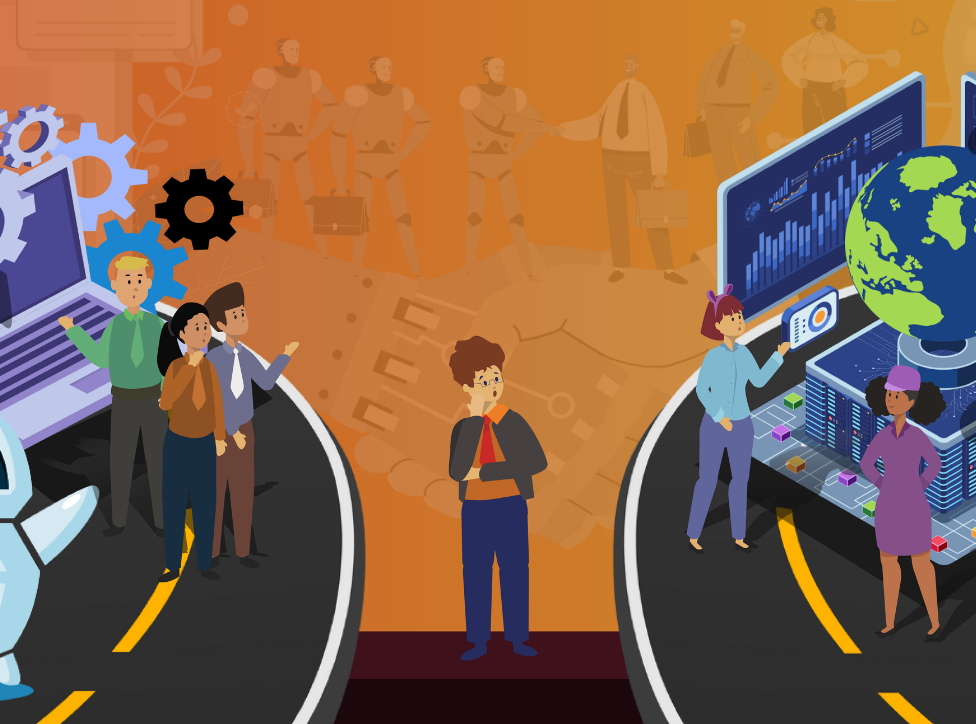

A few months ago, I was invited to observe how AI was being integrated into a Fortune 100 company’s operations. When I walked into the conference room, the whiteboards were covered – flowcharts, decision trees, AI integration plans, pages upon pages of automation roadmaps. The team was waiting for me to be impressed.
“What do you think?” one of the senior engineers asked, expecting validation.
I looked around, scanning the intricate maze of diagrams. Then, I said the only thing that came to mind:
“I think you’re missing the whole point.”
“What do you mean, Amit?”
“Tell me, where will AI give the most value? In automation, or in helping us explore how to optimize?”
Silence. A few nervous chuckles. But they knew exactly what I meant.
They had mapped their existing world in painful detail. Not once had they asked whether that world even needed to exist.
That’s the problem with how most organizations are approaching AI today. They assume faster means better. But AI applied to an inefficient process does not create innovation – it just scales inefficiency at an exponential rate.
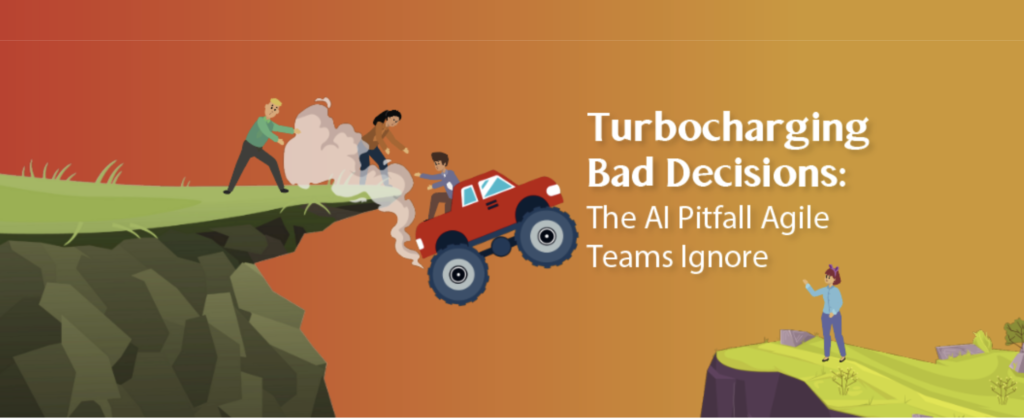
Most organizations are not innovating with AI – they’re just automating old inefficiencies. It’s the corporate equivalent of turbocharging bad decisions – using cutting-edge tools to speed up a flawed process instead of rethinking if that process even needs to exist.
This is exactly what I saw in the Fortune 100 company I worked with. They were obsessed with automating their call support workflows as quickly as possible. But in their rush, no one stopped to ask:
It took one conversation – one heated debate among their tech team – to uncover the real problem. They weren’t using AI to innovate; they were using it to copy-paste inefficiencies at scale.
And that’s the real danger. The illusion of progress.
If you take a broken, outdated process and use AI to make it move faster, what will you really achieve?
Not much. You’ve automated waste.
Don’t use AI to replicate human inefficiencies at scale – use AI to challenge them. But that requires a mindset shift:
This is exactly what was happening at this fortune 100 company. Once we stopped treating AI as a mere accelerator and started using it as a partner that could analyse, something changed.
Instead of blindly automating all workflows, the company re-engineered AI to analyze processes first, detect redundancies, and flag unnecessary steps. Instead of scaling inefficiencies, they were now systematically removing them.
Here’s what we did differently:
The impact was clear: AI didn’t just automate work – it helped redesign how work happens.
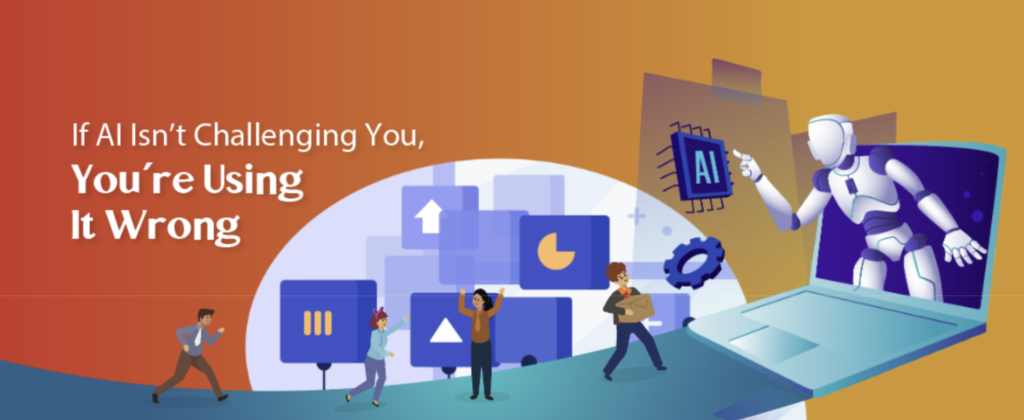
AI is a force multiplier. But what are you multiplying?
Are you scaling efficiency, or are you scaling waste?
Most companies get caught in the automation trap – pushing AI to move faster without stopping to ask: Is this even the right direction?
I believe AI in Agile should be more than just a fancy speed boost – it should be a thought partner. It should tell us:
If your AI isn’t challenging you, you’re not using it right.
So, before you invest in AI, ask yourself one hard question:
Are you using AI to transform work?
OR
Are you just making bad decisions… faster?
Have you seen AI used to redefine work, or just to replicate it? Drop a comment – I’d love to hear your thoughts.
This post combines the author’s personal thoughts, ideas, and experiences, with some refinement provided by our Agile Bot AgiNomi.
If you’re leading a high-stakes initiative – in tech, AI, or innovation – OutcomeEdge is here to make sure it actually lands.
We partner with visionary leaders ready to move fast, align their teams, and deliver real impact.
You’ve got great people. But results are stuck. Our Outcome Discovery workshop reveals the root causes behind delivery slowdowns, misaligned priorities, and team fatigue.
Too many teams are overbuilt, underpowered, or unclear. We help you design outcome-focused pods: right size, right skills, right rituals.

Agile Coach
I’m a leader who serves as an Agile Coach in organizations.
I help senior leadership plan long-term strategic decisions while embracing the Agile mindset.
I also work with teams to help them become self organizing on their journey of providing value to the customers.
I see my clients as creative, resourceful, and whole and I’m here to walk alongside them to achieve business outcomes.

Transformation Partner (Agilonomics)
Amitabh (Amit) Sinha is a global transformation leader who helps organizations supercharge their teams and eliminate dysfunctions. Drawing on Patrick Lencioni’s Five Dysfunctions of a Team framework, Amit guides teams to move up the maturity curve—building trust, fostering accountability, and aligning around outcomes.
As Founder of Agilonomics, he has enabled Fortune 500 companies and high-growth organizations to set up teams the right way—establishing processes that actually work, scaling collaboration across business and technology, and introducing the right tools with the right practices.
In partnership with Recro, Amit ensures that every team built through Recro is not only staffed with top talent, but also equipped to function as one unit, deliver consistently, and create lasting impact.