
For decades, project management has relied on one central artifact: the work item. Tasks, stories, or issues get broken down, logged, and tracked across boards and workflows. This approach gave teams visibility and structure, but it also created a heavy reliance on manual updates. Today, with the rapid rise of AI, we have to ask: do we still need to manage every piece of work through static items, or is there a smarter way to organize and deliver?
Work items were never the real goal. They were meant to create alignment, ensure nothing slipped through the cracks, and provide leaders with a sense of progress. Yet in many teams, they became a chore – filled out reluctantly, updated inconsistently, and checked more for compliance than collaboration.
This is where AI in project management changes the equation. Conversations can now be transcribed and tagged automatically. Meeting insights can be converted into action items without manual input. Dependencies can be spotted in real time. Instead of relying on work items as the only source of truth, teams can lean on intelligent systems that update themselves.
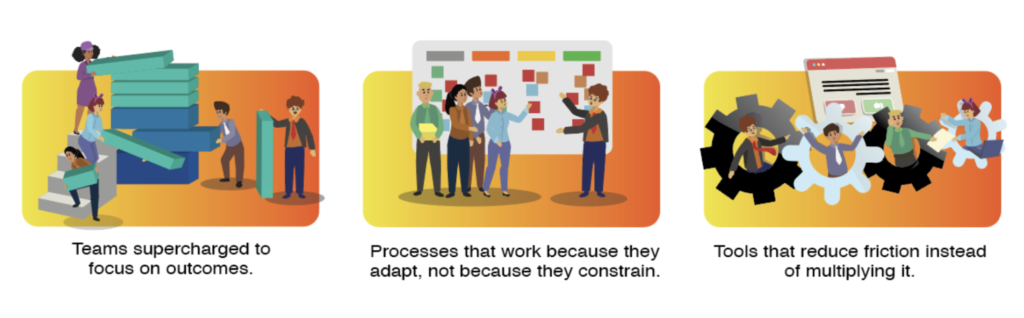
With this shift, teams move from administrating work to delivering value. A team supercharged by AI spends less time maintaining boards and more time focusing on outcomes. The conversation shifts from, “Did you update the work item?” to, “What do we deliver next?”

Some may wonder: without work items, how do we keep structure? The reality is that work items alone never guarantee a good process. They reflected it – or revealed the lack of it.
A process that works in the AI era is less about rigid artifact management and more about seamless coordination. Intelligent tools can surface patterns, highlight risks, and provide reminders when needed. Leaders can shift their energy from monitoring updates to guiding direction. Teams gain back time for collaboration that creates real impact.
The key is moving from work-item-driven project management to outcome-driven project management. That means:
The Future of Technology and Tools
If work items shaped the last generation of project management, AI-powered platforms will shape the next. Tools are no longer passive repositories of information; they are becoming active partners in execution.
Picture a platform that:
This isn’t far-off speculation – it’s already happening. The question is whether leaders will continue to center their processes on manual work items or embrace tools that extend human capability.
Technology, however, is not a substitute for leadership. No system can create trust, resolve conflict, or set vision. Servant Leadership and leaders who empower rather than control will make a huge difference on how effective are your AI tools
So, while AI tools work to remove administrative drag and provide clarity at scale, leaders and teams will get the space to focus on the human side of project management.
So, do we really need work items anymore? Not in the way we once did. They may still serve compliance or large-scale coordination needs. But as AI reshapes project management, the reliance on static work items will shrink.
What emerges instead is a more natural rhythm of work:
The real shift is not about abandoning structure but about reimagining project management with AI as an enabler. The future will not be measured by how many work items a team closes, but by how effectively they deliver value to the people they serve.
This post combines the author’s personal thoughts, ideas, and experiences, with some refinement provided by our Agile Bot AgiNomi.
If you’re leading a high-stakes initiative – in tech, AI, or innovation – OutcomeEdge is here to make sure it actually lands.
We partner with visionary leaders ready to move fast, align their teams, and deliver real impact.
You’ve got great people. But results are stuck. Our Outcome Discovery workshop reveals the root causes behind delivery slowdowns, misaligned priorities, and team fatigue.
Too many teams are overbuilt, underpowered, or unclear. We help you design outcome-focused pods: right size, right skills, right rituals.

Agile Coach
I’m a leader who serves as an Agile Coach in organizations.
I help senior leadership plan long-term strategic decisions while embracing the Agile mindset.
I also work with teams to help them become self organizing on their journey of providing value to the customers.
I see my clients as creative, resourceful, and whole and I’m here to walk alongside them to achieve business outcomes.

Transformation Partner (Agilonomics)
Amitabh (Amit) Sinha is a global transformation leader who helps organizations supercharge their teams and eliminate dysfunctions. Drawing on Patrick Lencioni’s Five Dysfunctions of a Team framework, Amit guides teams to move up the maturity curve—building trust, fostering accountability, and aligning around outcomes.
As Founder of Agilonomics, he has enabled Fortune 500 companies and high-growth organizations to set up teams the right way—establishing processes that actually work, scaling collaboration across business and technology, and introducing the right tools with the right practices.
In partnership with Recro, Amit ensures that every team built through Recro is not only staffed with top talent, but also equipped to function as one unit, deliver consistently, and create lasting impact.