

In every organization, delivery depends on more than plans and processes. It depends on accountability – that invisible thread connecting commitment, clarity, and follow-through. When that thread weakens, delivery falters, and no tool, dashboard, or ceremony can hold the line for long.
Teams often begin strong. They have a shared goal, a delivery rhythm, and confidence in each other’s roles. But over time, something shifts. Ownership blurs. Deadlines slip. The sense of shared responsibility fades into routine. Work gets done, yet no one can quite say who owns the outcome. The system still moves, but the energy behind it has thinned.
The Disappearing Act of Ownership
Accountability rarely disappears in a single moment – it erodes. It fades when priorities shift faster than context is shared. It weakens when leaders mistake visibility for alignment. It collapses when everyone assumes “someone else” will follow through.
Modern project management tools give us impressive visibility: who’s assigned, what’s due, what’s blocked. Yet these same tools can create an illusion of control. When every task has an owner on paper, it’s easy to believe ownership exists in practice. The truth is, ownership isn’t a column in a tracker – it’s a mindset that lives in the team.
Without that mindset, the flow of delivery becomes mechanical. Teams move work items forward, but meaning and purpose drain away. The question shifts from “Are we achieving our goal?” to “Is my part done?” – and the difference between those two questions determines the strength of delivery.
Supercharging Teams with Real Accountability

Technology and process should exist to strengthen human connection, not replace it. Accountability grows in teams that talk openly about expectations and outcomes. It grows when leaders model responsibility, not blame.
AI and automation can now predict delays, identify blockers, and summarize progress in real time – powerful capabilities for any delivery team. But these tools cannot replace the human discipline of ownership. They can surface risks, yet they cannot care. They can notify, yet they cannot commit.
To supercharge teams, accountability must shift from who is responsible for the task to who is committed to the result. That shift changes everything:
Accountability, in its truest form, is not enforced – it’s chosen.
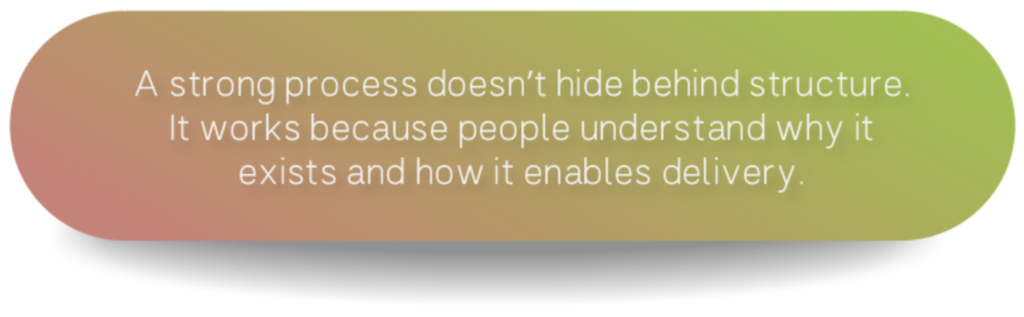
A strong process doesn’t hide behind structure. It works because people understand why it exists and how it enables delivery. When accountability fades, the process becomes heavy – meetings feel obligatory, updates feel rehearsed, and learning stalls.
To create a process that truly works, leaders need to:
AI can enhance each of these – surfacing insights, mapping dependencies, and reducing manual work. But accountability still depends on the people using it.
The Line Between Delivery and Drift
When accountability vanishes, delivery does not fail overnight – it fades quietly. Teams start meeting expectations instead of exceeding them. Discussions turn cautious. Risks go unspoken. The culture of ownership gives way to compliance.
So, who holds the line for delivery? The answer is simple – everyone who believes the outcome matters. Every person who refuses to let “done” mean “almost.” Every leader who treats accountability not as control, but as commitment.
Technology will keep evolving, but accountability will always remain human. And in the end, that’s what keeps delivery real.
This post combines the author’s personal thoughts, ideas, and experiences, with some refinement provided by our Agile Bot AgiNomi.
If you’re leading a high-stakes initiative – in tech, AI, or innovation – OutcomeEdge is here to make sure it actually lands.
We partner with visionary leaders ready to move fast, align their teams, and deliver real impact.
You’ve got great people. But results are stuck. Our Outcome Discovery workshop reveals the root causes behind delivery slowdowns, misaligned priorities, and team fatigue.
Too many teams are overbuilt, underpowered, or unclear. We help you design outcome-focused pods: right size, right skills, right rituals.

Agile Coach
I’m a leader who serves as an Agile Coach in organizations.
I help senior leadership plan long-term strategic decisions while embracing the Agile mindset.
I also work with teams to help them become self organizing on their journey of providing value to the customers.
I see my clients as creative, resourceful, and whole and I’m here to walk alongside them to achieve business outcomes.

Transformation Partner (Agilonomics)
Amitabh (Amit) Sinha is a global transformation leader who helps organizations supercharge their teams and eliminate dysfunctions. Drawing on Patrick Lencioni’s Five Dysfunctions of a Team framework, Amit guides teams to move up the maturity curve—building trust, fostering accountability, and aligning around outcomes.
As Founder of Agilonomics, he has enabled Fortune 500 companies and high-growth organizations to set up teams the right way—establishing processes that actually work, scaling collaboration across business and technology, and introducing the right tools with the right practices.
In partnership with Recro, Amit ensures that every team built through Recro is not only staffed with top talent, but also equipped to function as one unit, deliver consistently, and create lasting impact.