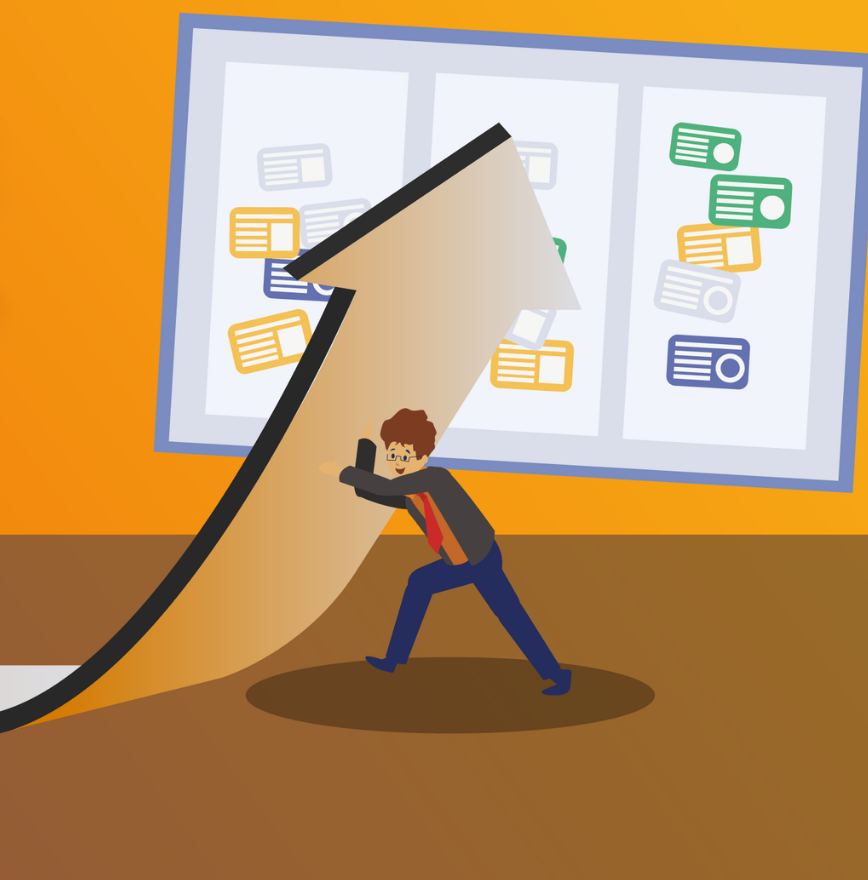

People often talk about burnout as if it arrives with alarms and flashing lights. In reality, it arrives quietly. It builds through the steady pull of small demands, quick pings, shifting expectations, and the pressure to remain available at all times. Many Scrum Masters and Project Managers carry this weight daily, and the strain shows long before anyone mentions it.
The modern work rhythm rewards responsiveness. Messages come in from every direction – chat apps, email, calls, calendar invites that appear the moment a gap opens. The workday turns into a sequence of rapid-fire context switches. Leaders move from coaching a team, to reviewing a plan, to jumping into an escalation, often without a single moment to breathe between them.
It feels manageable in the beginning. Then the accumulation hits.

The demand is not only in tasks. It’s in attention. Leaders hold space for decision-making, team dynamics, conflict navigation, delivery pressure, and the emotional climate of the group. When this weight meets constant interruption, the decline begins.
Sleep slips. Focus blurs. Days stretch into evenings. The advantage of being an early starter disappears when meetings begin at sunrise and end at midnight due to distributed teams in multiple timezones. Personal time dissolves into “quick checks” that consume the rest of the day.
The slow decline is the real threat – because it’s harder to detect, harder to admit, and harder to interrupt.
Healthy leadership requires capacity. Capacity requires boundaries. Without them, even the strongest leaders flatten under the weight of continual availability.
The leaders who stay effective the longest do something simple but uncommon: they establish limits and follow them. Not because they want less work, but because they want to show up with clarity and intention instead of fatigue.
Here are the practices that consistently rebuild stability – not hacks, but disciplined choices:
A leader cannot guide teams if they spend the entire day reacting. Protecting blocks for focused thinking is essential, even if these blocks sometimes get compromised. The act of defending them signals that attention is an asset, not a free resource.
2. Rhythm for non-urgent communication
Not every request requires immediate presence. Establishing space for slower, thoughtful responses helps reset expectations and prevents the “always on” trap.
3. Predictable touchpoints with team members
Fixed 1-on-1 conversations maintain alignment without constant interruptions. It also gives people confidence that support exists without needing to chase it.
4. Clear limits on weekly responsibilities
Leaders who define what they can realistically absorb – interviews, assessments, pre-sales, support requests – make better decisions for themselves and their teams.
5. Purposeful async collaboration
Distributed teams run smoother when asynchronous channels handle routine work. It reduces the need for late-night calls and early-morning emergencies.
6. Consistent personal routines
Sleep, movement, and quiet moments act as stabilizers. They don’t fix everything, but they anchor the leader during demanding periods.
7. Space for interests outside work
Side projects, hobbies, and personal pursuits refill energy in ways that productivity techniques never will.
None of these are silver bullets. Some days they hold, other days they barely make a dent. Leadership sits in the tension between intention and reality – learning what restores energy, what drains it, and what must change.
Sustainable leadership is not built on endurance – it is built on discipline. The discipline to pause. The discipline to decline. The discipline to step back before the work consumes more than it returns.
The question is no longer whether burnout is a risk. It is.
The question is whether leaders are willing to draw the line early enough to lead well – not for a quarter, but for the long haul.
This post combines the author’s personal thoughts, ideas, and experiences, with some refinement provided by our Agile Bot AgiNomi.
If you’re leading a high-stakes initiative – in tech, AI, or innovation – OutcomeEdge is here to make sure it actually lands.
We partner with visionary leaders ready to move fast, align their teams, and deliver real impact.
You’ve got great people. But results are stuck. Our Outcome Discovery workshop reveals the root causes behind delivery slowdowns, misaligned priorities, and team fatigue.
Too many teams are overbuilt, underpowered, or unclear. We help you design outcome-focused pods: right size, right skills, right rituals.

Agile Coach
I’m a leader who serves as an Agile Coach in organizations.
I help senior leadership plan long-term strategic decisions while embracing the Agile mindset.
I also work with teams to help them become self organizing on their journey of providing value to the customers.
I see my clients as creative, resourceful, and whole and I’m here to walk alongside them to achieve business outcomes.

Transformation Partner (Agilonomics)
Amitabh (Amit) Sinha is a global transformation leader who helps organizations supercharge their teams and eliminate dysfunctions. Drawing on Patrick Lencioni’s Five Dysfunctions of a Team framework, Amit guides teams to move up the maturity curve—building trust, fostering accountability, and aligning around outcomes.
As Founder of Agilonomics, he has enabled Fortune 500 companies and high-growth organizations to set up teams the right way—establishing processes that actually work, scaling collaboration across business and technology, and introducing the right tools with the right practices.
In partnership with Recro, Amit ensures that every team built through Recro is not only staffed with top talent, but also equipped to function as one unit, deliver consistently, and create lasting impact.